
I’ve met loads of professionals in Thailand who use English at work every day, particularly at the managerial and executive levels.
Many speak excellent English. Some probably have a better grasp of English grammar than I do, especially when I’m speaking with friends and not paying close attention to my form.
But even among highly proficient English speakers, something can still be missing when they communicate in high-level business situations.
● ● ●
It’s one thing to lead a meeting or give a presentation in coherent English.
It’s another to do it with confidence and authority.
At senior levels, communication is judged on more than whether the grammar is correct. People notice how clearly you make a point, how concisely you answer a question, how you use your voice, how you handle pressure, and how composed you appear under pressure.
These are all elements of Executive Presence.
Speaking English with Executive Presence can be challenging when English is your second language. You may know what you want to say, but still hesitate, speak too fast, speak too slow, or become flustered when someone asks an unexpected question.
● ● ●
Confidence and Authority Are Not the Same Thing
Confidence is trusting your professional judgment and saying what comes to mind without hesitation.
Authority is how clearly, calmly, and decisively you say it.
A senior leader can speak accurate English but because they have hesitated they sound unsure of themselves. This demonstrates a lack of confidence.
Or, they may over-explain, use too many filler words, avoid being direct, or “ramble” after making their point. This demonstrates a lack of authority.
The solution to these deficiencies is rarely more grammar lessons or larger vocabulary lists. It is usually learning how to use existing English ability with greater control.
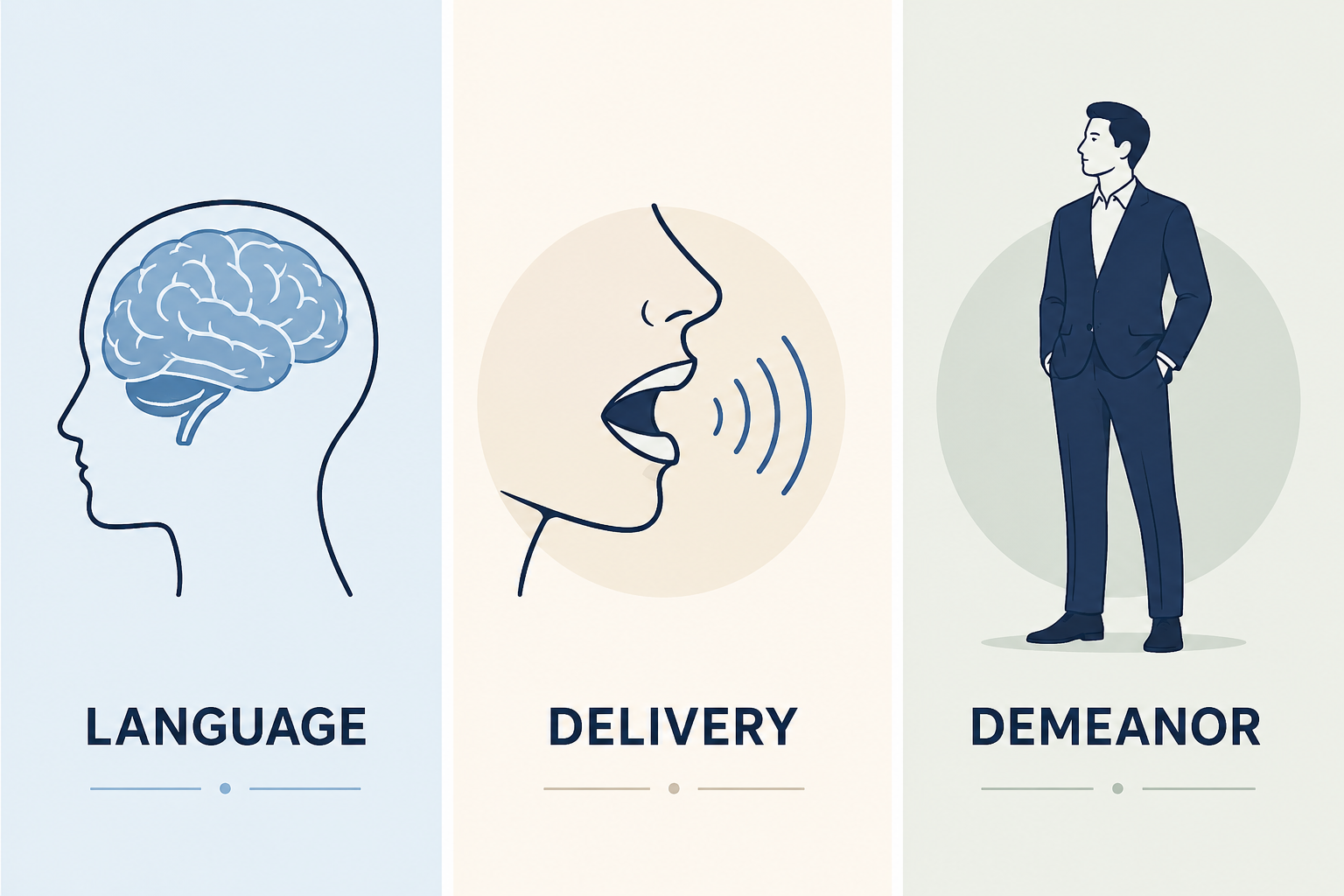
At ECSC Thailand, we organize the development of greater control around three interconnected areas: Language, Delivery, and Demeanor.
Together, we call this LDD.

Let's Chat
Looking for English Coaching that develops Executive Presence? Send Us a Message
LANGUAGE
The words you choose and how effectively you use them in business situations.
At the executive level, this is not about memorizing long lists of business vocabulary. It is about understanding the common phrases, questions, and expressions that are useful in the situations where executives must communicate.
For executives in Thailand, that might mean:
- Explaining technical or financial information clearly
- Giving concise, on-point updates during business meetings
- Answering difficult questions without unnecessary hesitation
- Interrupting politely or carefully redirecting discussions
- Handling executive-level small talk more naturally
The objective of developing Executive Presence is to make the language needed in those situations available automatically, because senior professionals rarely have many minutes to craft perfect sentences before responding.
● ● ●
DELIVERY
How you sound: pronunciation, pace, pauses, clarity, conciseness, emphasis, and tone.
In leadership environments, these skills all affect how your spoken messages are received.
Those who speak too quickly may appear nervous. Those who rarely pause or take breaths may speak in run-on sentences that don’t allow listeners to identify the key points, and someone who circles around a key point may come across as unsure or worse, dishonest.
A bit of guidance and practice can help you eliminate the most common problems, such as:
- Speaking too quickly
- Failing to pause at the right moments
- Losing pronunciation and clarity when under pressure
- Overusing filler words and phrases such as “uh,” “um,” or “know what I mean?”
- Speaking in long streams without emphasizing key points
These are often habits rather than deficiencies in English ability. And habits can be changed through identification, feedback, and repeated practice.

Let's Talk
Want to explore Executive English Coaching for yourself or other senior leaders? Give Us a Call
DEMEANOR
How you present yourself: confidence, composure, appropriate gestures, and other nonverbal behavior.
This includes posture, eye contact, facial expressions, where you look, how you sit, what you do with your and hands, and your overall physical appearance.
Strong demeanor does not mean putting on a performance. In many cases, it means removing distracting behavior such as nervous movement, looking away while making an important point, or smiling and laughing when discussing a serious issue.
The aim is for the speaker’s physical behavior to support the message rather than weaken it.
For upper-level Thai professionals who communicate with regional leadership teams, Western clients, or other global stakeholders, demeanor could be the most important thing they observe about you.
Remember, first impressions are critical, and someone’s mere perception of who you are often forms their reality.
● ● ●
Executive Presence Is Coachable
For an executive who already speaks good English, another grammar lesson may have very little impact on how effectively that person leads a meeting, handles challenging questions, presents an important idea, or influences international stakeholders.
Improvement lies in developing stronger Language, Delivery, and Demeanor when communicating in English with other high achievers. Improvement lies in the development of Executive Presence.
● ● ●
Further Reading:
Learn more about our Executive English Coaching programs and how they are built on our English Plus approach to building professional English communication skills.
Or visit our Contact Us to send us a message about our other communication skills training services.
● ● ●